
Every disabled child has the right to play, learn and belong.
Disabled children are among the most excluded members of society worldwide.¹ Harmful beliefs, a lack of support services and exclusion from education and healthcare keep many isolated from their communities. That leaves them far more exposed to harm, abuse and neglect: disabled children are four times more likely to experience abuse than other children.²
Poverty makes every barrier higher. In the poorest communities, with no services to turn to, disabled children are often kept at home, missing out on school, medical care, friendship and sometimes even food. Harmful beliefs, such as the idea that disabled children are "cursed", let this exclusion go unchallenged.
This is unacceptable, and it is preventable.
What we do
Since 2011, we have been developing practical, sustainable and effective ways to tackle exclusion in low-income communities. The result is the Disability Africa Model: a tried and tested approach built on a simple idea, play.
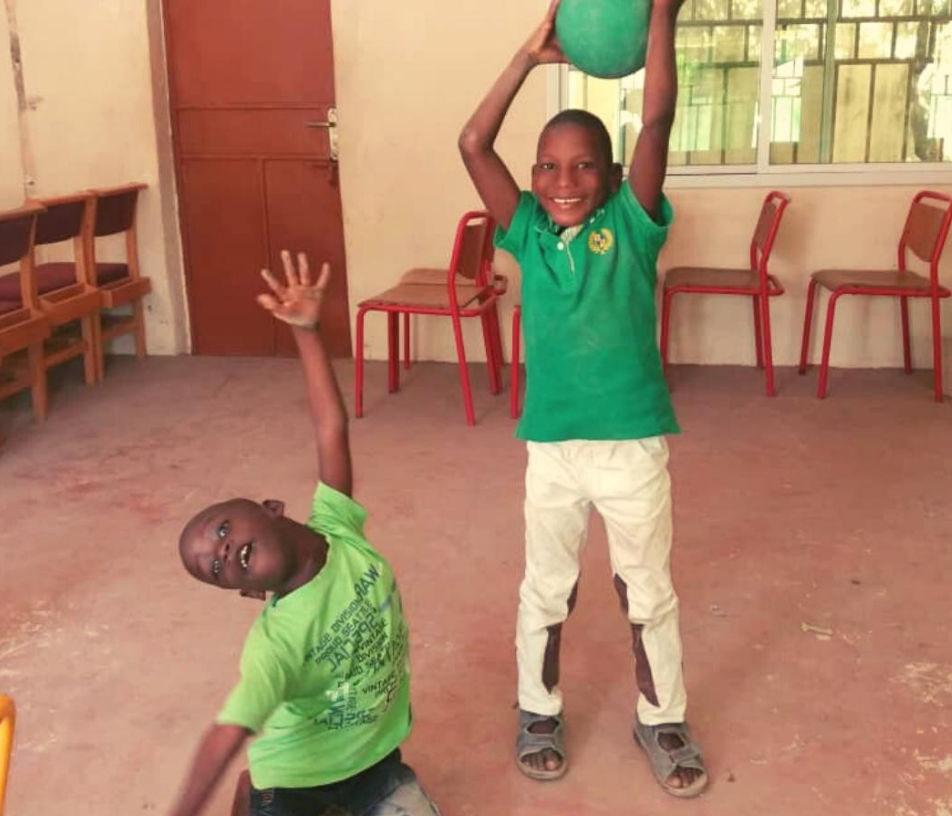
Our partner organisations in Kenya, The Gambia, Zambia, Uganda and Eswatini run community play schemes. These are safe, welcoming spaces where disabled children leave the house, play, make friends and become part of community life. From there, our partners improve access to vital support, such as healthcare, therapy, family support and education, and advocate for disabled children's rights. As children become visible in their communities, attitudes start to change.
What makes us different
Led by our partners. Our partners are independent community organisations. They lead the work, employ local teams and set their own goals. We back them with funding, organisational support and the Disability Africa Model.
In it for the long term. We don't fund a project for a year and move on. Disability Inclusion requires significant attitudinal shift combined with practical support, which takes time. Our partnerships last, so children and families can rely on support that's still there next year and beyond, until real change is established in a community.
Close to the work. We work alongside our partners week in, week out. We help with budgets and planning, research, advice and organizational resilience. We know the children and families each project supports, and where your donation goes. Every community is different, and we adapt our support to its context.
Lean in the UK. A small UK team, supported by a network of volunteers, keeps our costs low, so more of every pound goes to communities.
Progress, not pity. Africa is a continent of 54 countries and thousands of communities, each with its own history, languages, cultures and strengths. We don't reduce it to a single story. We back the progress African communities are already making, led by the people who live there. The stories we share are about what children, families and partners achieve, not what they lack. We don't support voluntourism, and we only use a photo or story to fundraise when we have consent for that use.
Inclusion benefits everyone.
Tackling these inequalities makes all of us who take part better off.
¹ UNICEF (2021), Seen, Counted, Included · ² Jones et al. (2012), The Lancet. These are the same sources your annual report cites.


Watch our Videos
To learn more about our approach, and see recent progress and updates across our projects.

The Case for Inclusion
Disability Africa’s innovative approach to disability in low and middle income countries.

Meet our patrons
"Disabled young people all over the world face unfair inequality of opportunities, but in parts of Africa conditions can be unimaginably hard." Damon Hill OBE
Our blogs
Learn more about our work, successes and challenges facing past, present and future projects.